
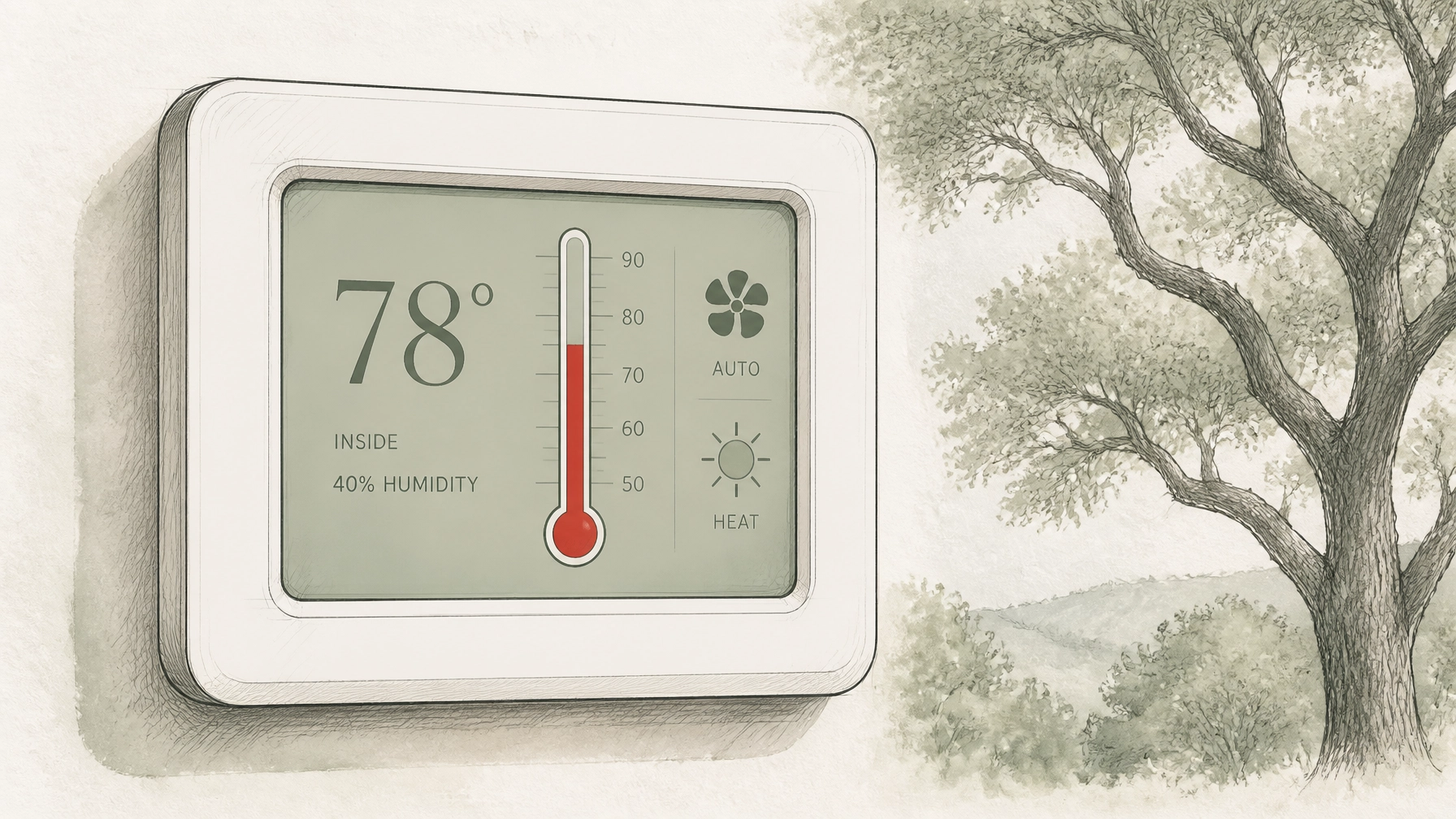
The Texas Hill Country retirement lifestyle has plenty to recommend it: quiet roads, historic towns, winery visits, golf, open skies, and evenings on a shaded porch. But every summer, there is another cost of that lifestyle that deserves attention: the price of keeping the house comfortable.
For retirees living on a predictable income, an electric bill that rises sharply from June through September can quietly reshape the household budget. The challenge is not necessarily that Texas has the highest electricity prices in the country. In fact, the U.S. Energy Information Administration reported an average residential electricity price of 15.26 cents per kilowatt-hour in Texas in June 2025, compared with 17.47 cents nationally.
The bigger issue is usage. Texas homes often require extensive air conditioning during long, hot summers. A lower price per kilowatt-hour does not always translate into a lower monthly bill when the home is using substantially more electricity.
What cooling can really cost in the Hill Country
Consider a simple example. At 15.26 cents per kilowatt-hour:
- An additional 300 kilowatt-hours costs approximately $46.
- An additional 500 kilowatt-hours costs approximately $76.
- An additional 1,000 kilowatt-hours costs approximately $153.
Those figures are before taxes, delivery charges, base fees, and other plan-specific costs. They are also not predictions for any specific household. They simply show how quickly cooling-related usage can become a meaningful expense.
A smaller, newer, well-insulated home may remain relatively efficient. An older ranch-style property with high ceilings, large windows, aging ductwork, or limited attic insulation may require much more energy to maintain the same indoor temperature.
That difference matters in retirement. A $75 increase in a summer bill may be manageable. A $200 or $300 increase, repeated for several months, can compete with money intended for dining, travel, healthcare, charitable giving, or home maintenance.
“Keeping your home at a comfortable temperature can be expensive,” notes ENERGY STAR’s guidance on air-source heat pumps.

Start with an energy audit: not a guess
The first step is not automatically replacing the air conditioner. It is understanding where the home is losing efficiency.
A professional home energy audit can examine:
- Attic insulation and ventilation
- Air leaks around windows, doors, vents, and electrical penetrations
- Ductwork in attics, crawl spaces, and garages
- The age and condition of the air-conditioning system
- Thermostat settings and operating patterns
- Moisture, shading, and solar heat entering the home
- Whether rooms are consistently hotter or colder than others
Some audits include blower-door testing or infrared imaging. These tools can reveal problems that are not obvious during a normal walk-through.
Retirees should request a written report that ranks improvements by expected benefit, cost, and urgency. That approach is more useful than accepting a vague recommendation to “upgrade everything.”
If an expensive project is recommended, obtain more than one estimate and ask whether the contractor can explain the expected effect on comfort and electricity use. The best improvement is not always the newest equipment. Sometimes the highest-value project is sealing duct leaks or improving attic insulation.
Insulation and air sealing can reduce the workload
In a hot Texas climate, the attic and building envelope deserve particular attention. Weak insulation allows heat to move into the living space, while air leaks can allow conditioned air to escape.
Useful improvements may include:
- Adding or leveling attic insulation
- Sealing gaps around plumbing, wiring, and recessed lighting
- Weatherstripping exterior doors
- Caulking gaps around windows and trim
- Sealing duct connections
- Insulating exposed ductwork
- Installing solar screens, exterior shades, or well-placed window coverings
- Improving attic ventilation where appropriate
The sequence matters. Air sealing should generally be addressed before adding insulation so that leaks are not hidden beneath new material.
These upgrades can also improve comfort. A home that holds its temperature more consistently may allow the air conditioner to run less often without requiring residents to tolerate uncomfortable indoor conditions.
For Hill Country homeowners, the goal is not to turn a historic home into a sealed box. It is to preserve its character while reducing unnecessary heat gain and cooled-air loss.
Consider heat pumps when equipment needs replacing
When an aging air-conditioning system is approaching the end of its useful life, a heat pump may be worth evaluating. An air-source heat pump can provide cooling in the summer and heating during cooler months by moving heat rather than creating it through combustion.
ENERGY STAR explains that a heat pump can provide both heating and cooling, making it a year-round system rather than a single-purpose replacement.
That does not mean a heat pump is automatically the right choice for every home. The system must be sized correctly, installed properly, and matched to the home’s ductwork and insulation. ENERGY STAR recommends that contractors use a Manual J load calculation to determine the appropriate equipment size.
Before approving a replacement, ask:
- Has the home been evaluated for air leaks and insulation problems?
- Is the proposed system correctly sized for the home?
- Will the existing ductwork support the new equipment?
- What maintenance will be required?
- What is the estimated total cost, including installation?
- Are utility rebates or other incentives currently available?
A large equipment purchase should be considered alongside the rest of the household’s needs. Efficiency is valuable, but an expensive upgrade should not force a retiree to neglect more urgent repairs or reduce necessary cash reserves.

Budget billing can smooth the bumps: but it does not lower the cost
Budget billing, also called average monthly billing by some providers, can make summer energy expenses easier to anticipate. The provider estimates an annual cost and spreads payments more evenly throughout the year.
For someone living on Social Security, a pension, or scheduled portfolio withdrawals, this can reduce the surprise of a very high July or August bill.
But budget billing is a payment-smoothing tool, not a discount. It does not automatically reduce electricity usage or change the underlying rate. Depending on the provider, actual charges may be tracked and reconciled later through a true-up or cumulative balance.
Before enrolling, ask:
- How is the monthly amount calculated?
- How often is it recalculated?
- Is there a true-up?
- What happens if you move or cancel service?
- Can the provider increase the payment during the year?
- Will the bill still show actual monthly usage?
Budget billing may help with cash flow, but retirees should continue monitoring actual kilowatt-hour usage. Otherwise, an accumulating balance can remain invisible until it becomes a problem.
Treat time-of-use plans carefully
Some Texas electricity plans charge different rates depending on when power is used. These time-of-use plans may offer lower prices overnight or during selected periods and higher prices during peak hours.
That structure can work well for a household able to shift flexible activities, such as laundry, dishwashing, pool pumping, or electric-vehicle charging. However, air conditioning is not always flexible. In the hottest part of the day, the system may need to run regardless of the rate.
Before considering a time-of-use plan:
- Review the plan’s Electricity Facts Label through Texas electricity resources.
- Check the exact peak and off-peak hours.
- Review fixed charges, minimum-use fees, and contract terms.
- Examine your hourly usage through Smart Meter Texas, where available.
- Consider whether you are home during peak afternoon hours.
- Compare the plan against your actual usage pattern: not just its advertised lowest rate.
A time-of-use plan may be useful for one household and expensive for another. The answer depends on habits, equipment, home design, and the specific plan.

Build energy costs into a sustainable withdrawal plan
Electricity should be treated as a seasonal household expense, not an afterthought.
A practical approach is to review at least 24 months of electric bills and separate them into:
- A normal monthly baseline
- Summer cooling costs
- Winter heating costs
- One-time equipment or repair expenses
- Any unusual weather-related spikes
Then create a higher-cost summer estimate. For example, if a household normally spends $150 per month but reaches $325 during the hottest months, the annual plan should reflect those higher bills rather than assuming every month will resemble spring.
This can help create a more realistic spending schedule:
- Estimate the annual energy cost using both mild and extreme months.
- Set aside a dedicated reserve for HVAC repairs or replacement.
- Schedule efficiency upgrades during a period when cash flow is strongest.
- Revisit the estimate after insulation, ductwork, or equipment changes.
- Keep enough liquid savings available for an unexpected failure during a heat wave.
The same principle applies to a broader retirement income plan. A withdrawal strategy should account for essential expenses that fluctuate, especially utilities, insurance, healthcare, and property maintenance. Previous research on retirement spending and the so-called 4% rule can provide additional context, but every household needs a plan based on its own home, lifestyle, and resources.
At Mau Sanchez Capital, retirement planning is designed around the individual household: not a generic spending formula. That may include evaluating the role of cash reserves, publicly traded investments, traditional fixed income, and long-term equity ownership while keeping the portfolio liquid and understandable.
Staying cool without sacrificing the retirement lifestyle
The answer is not necessarily to avoid air conditioning or accept an uncomfortable home. A more durable solution is to make cooling costs visible, reduce waste where practical, and plan for the months when Texas heat places the greatest demand on the household.
For Hill Country retirees, energy efficiency can support more than a lower bill. It can make an older home more comfortable, extend the life of major equipment, protect cash flow, and help preserve the freedom to enjoy the retirement lifestyle that made the Hill Country attractive in the first place.
Schedule a private meeting with a fiduciary financial advisor today by calling (512) 593-8380 or by visiting: https://calendly.com/portafoliocapital/15min
Portafolio Capital Management dba Mau Sanchez Capital is a Registered Investment Adviser. This content is for informational purposes only and does not constitute investment advice or a solicitation to buy or sell any security. Advisory services are provided only pursuant to a written advisory agreement.
To learn more about retirement living, financial preparedness, and lifestyle opportunities across Texas, visit Texas Retirement Journal.
This article may include stories, scenarios, and perspectives created or assisted by artificial intelligence. Although the individuals and circumstances described may be fictional, the topics are intended to reflect real financial, personal, and lifestyle issues that retirees and individuals commonly face.
The content is provided to encourage readers to consider different perspectives that may affect their retirement, regardless of whether they are currently planning, approaching retirement, or already retired. It is intended for general educational and informational purposes only and should not be interpreted as personalized investment, financial, tax, legal, medical, or retirement-planning advice.
Individual circumstances vary. Readers should independently verify any information presented and consult appropriately qualified professionals before making financial or personal decisions. No advisory, professional, or client relationship is created through the use of this website.
Leave a Reply