
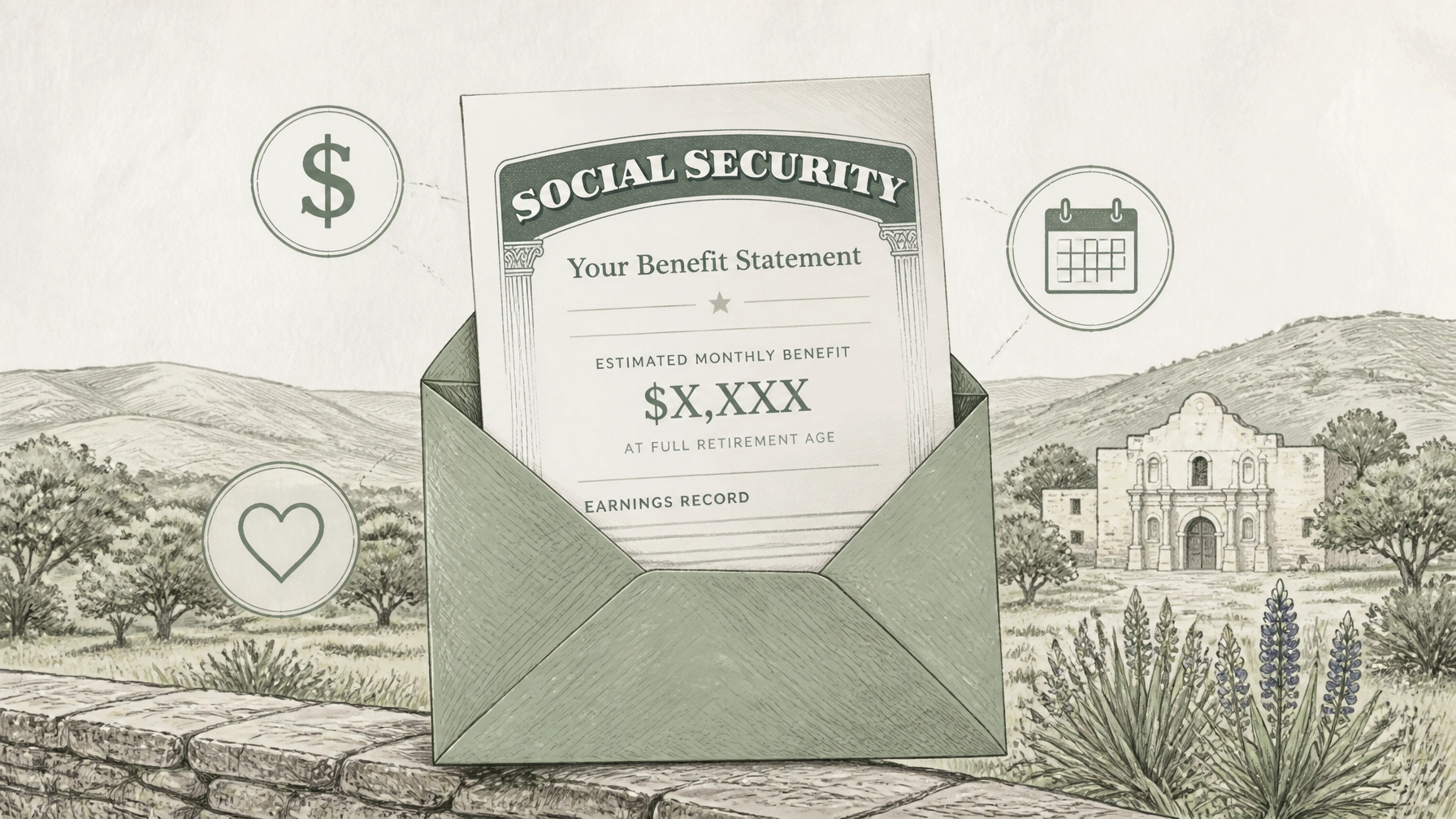
For many Texas retirees and pre-retirees, the Social Security Statement is one of the most useful: and most overlooked: retirement documents available.
The current statement is presented through your secure my Social Security account in a redesigned online format. It is intended to be easier to read than older paper statements, with visual benefit estimates, a year-by-year earnings history, and information about retirement, disability, and survivor benefits.
The report is not a promise of a specific payment. It is a planning snapshot based largely on your recorded earnings and current Social Security rules. Reading it carefully can help you identify mistakes early, understand your claiming choices, and coordinate Social Security with the rest of your retirement lifestyle.
As the Social Security Administration explains, “Your online Statement gives you estimates for retirement, disability, and survivor benefits that you and your family may be eligible for.” You can read the full SSA publication on correcting your earnings record.
How to Find Your 2026 Social Security Statement
To view your report, visit the Social Security Administration’s my Social Security account page and sign in or create an account.
Once inside, look for the option to view your Social Security Statement. Depending on your situation, you may be able to review:
- Estimated retirement benefits at multiple claiming ages
- Your complete earnings history
- Estimated disability benefits
- Potential survivor benefits for eligible family members
- Information about Social Security credits and eligibility
- General explanations of how benefits are calculated
The online statement may also appear alongside other notices and tools. Keep in mind that your annual benefit report is different from a cost-of-living adjustment notice, benefit verification letter, or a personalized message about an existing claim.
1. Start With the Estimated Retirement Benefits
The first section most people notice is the retirement benefit estimate. Rather than showing only one number, the redesigned report generally illustrates how your estimated monthly benefit may change depending on when you claim.
You may see estimates for several ages, including:
- Age 62, when many people first become eligible for retirement benefits
- Your full retirement age
- Ages beyond full retirement age, including age 70
The report may display these estimates in a chart or bar graph. The purpose is not to tell you which age to choose. It is to show the tradeoff between claiming earlier and waiting longer.
A lower estimate at age 62 does not necessarily mean you are making a mistake by claiming early. Likewise, a larger estimate at age 70 does not automatically make delayed claiming the right choice. Your decision may also depend on:
- How long you expect to work
- Your health and family longevity
- Whether a spouse depends on your income
- Other retirement income sources
- Your desired lifestyle in places such as the Texas Hill Country
- How much flexibility you want in your investment portfolio
The figures are estimates, not guarantees. They rely on the earnings recorded by the SSA and assumptions about future work. If you stop working earlier than expected, your final benefit estimate may differ from the projection shown today.
For a broader discussion of coordinating retirement spending and income, you may also want to read The 4% Rule Is Dead: What the New Retirement Spending Research Says for Texas Retirees.

2. Examine the Earnings Record Line by Line
Your earnings record is the foundation of the report. It lists the income reported to Social Security for each year of your working life.
This section deserves special attention because missing or incorrect earnings can affect more than your retirement estimate. Your earnings history may also influence potential disability benefits and survivor benefits for eligible family members.
Compare the report with your own records, especially for years when you:
- Changed employers
- Worked for more than one company
- Were self-employed
- Owned a business
- Changed your name
- Worked under a different name or Social Security number
- Had an unusually high-income year
- Experienced a merger, payroll transition, or employer closure
For business owners and professionals, self-employment years deserve particular care. Make sure the income you properly reported is reflected in the Social Security record. The earnings shown may not match every figure on a tax return because the report focuses on earnings subject to Social Security rules.
Recent earnings may take time to appear. The SSA notes that current-year or prior-year income may not yet have been posted. That does not mean the information is permanently missing. Still, it is wise to review the record regularly rather than waiting until you are ready to claim benefits.
3. Know What to Do If You Find an Error
If an earnings year is missing or the amount appears incorrect, do not simply assume it will fix itself.
First, gather documentation. Helpful records may include:
- W-2 forms
- Tax returns
- Pay stubs
- Wage statements
- Business income records
- Other documents showing where and when you worked
The SSA’s official earnings-record correction guide explains that you should provide as much information as possible, including the employer’s name, the dates worked, the amount earned, and the name or Social Security number used at the time.
You can contact Social Security through its online services, by telephone, by mail, or by scheduling an appointment. The agency’s main contact number is 1-800-772-1213.
Start early. Old employment records can be difficult to locate, particularly if a former employer has closed or changed ownership. Resolving a discrepancy may also take time if the SSA needs to contact an employer or review supporting documentation.
4. Review the Disability Information: Even If You Are Retired
The disability section is easy to skip if you are focused on retirement. However, it can help you understand another form of protection connected to your work history.
Your statement may show an estimated disability benefit if you were to become disabled and qualify under Social Security’s rules. The estimate is not an approval or guarantee of eligibility. Disability programs have specific requirements related to medical conditions, work history, and the ability to engage in substantial work.
The report may also indicate whether you have earned enough work credits for certain benefits. The number of credits required can depend on your age and when a disability occurs.
For someone still working in a demanding profession, running a business, or managing a ranch or other property, this information can be part of a larger income-continuity conversation. It may prompt you to review emergency reserves, insurance coverage, and how your investment portfolio would support your household if employment income stopped unexpectedly.
The SSA’s 2026 disability information includes updated program thresholds and work-related figures. These rules can change, so use the agency’s current information rather than relying on an old statement or article.

5. Do Not Overlook Survivor Benefits
Your online benefit report may also include estimates for survivor benefits. These figures are designed to show what certain eligible family members might receive if you die.
Survivor benefits can be relevant when couples are deciding how much income each person may need, particularly if one spouse has a substantially higher earnings record. They may also be important for families supporting a dependent child or another eligible family member.
The estimates are not a substitute for individualized advice, and eligibility rules can be complicated. Still, reviewing the section may help you identify questions worth discussing before making a Social Security decision.
6. Turn the Statement Into a Retirement Planning Checklist
After reviewing the report, write down the questions it raises. For example:
- Are all of my earnings listed correctly?
- Are the estimated benefits at different ages materially different?
- Am I assuming I will work longer than is realistic?
- Would my household budget work if one spouse died first?
- How would my investment portfolio support expenses before or after Social Security begins?
- Do I need more liquidity for healthcare, home repairs, or a future move?
- Should I revisit my retirement income plan as my desired lifestyle changes?
A Social Security estimate is only one part of a broader retirement picture. For someone considering a slower-paced life near Fredericksburg, Kerrville, or another Hill Country community, the practical question is not simply, “What will Social Security pay?”
It is, “How does this income fit with the life I want to live?”
That may include travel, dining, golf, charitable giving, supporting family, maintaining a larger home, or moving to a more retirement-friendly property. The answer depends on the relationship between guaranteed income, portfolio withdrawals, spending needs, and risk tolerance.
At Mau Sanchez Capital, retirement planning and investment management services are provided with an emphasis on client-specific portfolio design, appropriate asset allocation, liquidity, transparency, and publicly traded markets. The goal is to help clients evaluate Social Security as one component of a broader retirement income strategy: not as the entire plan.

Make Your Statement an Annual Habit
You do not need to wait until age 62 to review your Social Security Statement. Workers of all ages can use an online account to check their earnings history and estimated benefits.
For pre-retirees, an annual review can reveal errors while documentation is still available. For current retirees, the statement and related online notices can help you keep track of benefit information and household planning assumptions.
Treat the report as a starting point. Verify the earnings record, understand what the benefit estimates assume, and consider how the numbers fit with your desired Texas retirement lifestyle.
Schedule a private meeting with a fiduciary financial advisor today by calling (512) 593-8380 or by visiting: https://calendly.com/portafoliocapital/15min
Portafolio Capital Management dba Mau Sanchez Capital is a Registered Investment Adviser. This content is for informational purposes only and does not constitute investment advice or a solicitation to buy or sell any security. Advisory services are provided only pursuant to a written advisory agreement.
To learn more about retirement living, financial preparedness, and lifestyle opportunities across Texas, explore the Texas Retirement Journal retirement resources.
This article may include stories, scenarios, and perspectives created or assisted by artificial intelligence. Although the individuals and circumstances described may be fictional, the topics are intended to reflect real financial, personal, and lifestyle issues that retirees and individuals commonly face.
The content is provided to encourage readers to consider different perspectives that may affect their retirement, regardless of whether they are currently planning, approaching retirement, or already retired. It is intended for general educational and informational purposes only and should not be interpreted as personalized investment, financial, tax, legal, medical, or retirement-planning advice.
Individual circumstances vary. Readers should independently verify any information presented and consult appropriately qualified professionals before making financial or personal decisions. No advisory, professional, or client relationship is created through the use of this website.
Leave a Reply