
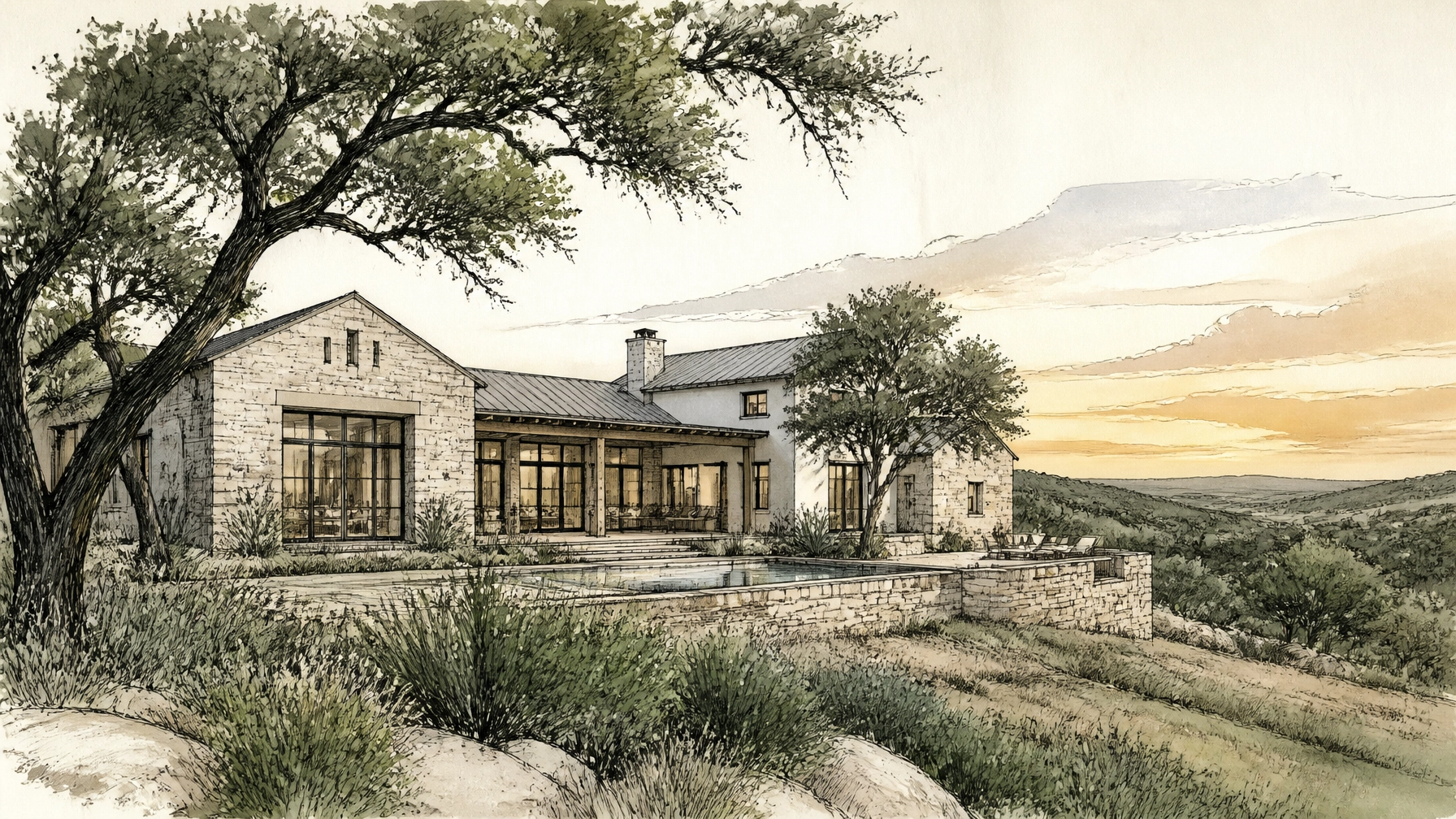
For many Texas families, the suburban "forever home" in the Greater Austin, Houston, or Dallas areas served its purpose beautifully. It was the backdrop for raising children, hosting holiday dinners, and building a life. But as retirement nears in 2026, many pre-retirees are finding that the four-bedroom colonial with the high-maintenance pool no longer fits their desired lifestyle.
The shift toward "luxury downsizing" isn't just about moving into a smaller footprint; it’s about upgrading your quality of life. It’s the trade-off between square footage you no longer use and the rolling vistas, slower pace, and community charm of the Texas Hill Country.
However, moving from a multi-million dollar suburban estate to a sophisticated Hill Country retreat requires more than just a moving truck. It requires a strategic financial plan, an understanding of the 2026 tax landscape, and a clear vision for your next chapter.
The $500,000 Opportunity: Understanding the Capital Gains Exclusion
One of the most powerful financial tools for Texas retirees in 2026 remains the IRS Section 121 exclusion. If you are married filing jointly, you can generally exclude up to $500,000 of the gain from the sale of your primary residence from federal income tax. For single filers, the exclusion is $250,000.
In a state like Texas, which has no state income tax, this is a significant advantage. If your suburban home has appreciated substantially over the last decade, this exclusion allows you to harvest that equity and redeploy it into your retirement lifestyle or your investment portfolio.
To qualify for this exclusion, you must meet the "ownership and use" tests:
- Ownership: You must have owned the home for at least two of the five years leading up to the sale.
- Use: You must have lived in the home as your primary residence for at least two of those five years.
As Mau Sanchez, founder of the Texas Retirement Journal and owner of Mau Sanchez Capital, often notes, "The home is frequently a retiree’s largest illiquid asset. Successfully navigating the sale is the first step in a broader wealth preservation strategy that ensures your lifestyle is supported by a liquid, transparent portfolio."
Strategic Selling: Staging for the Modern Luxury Buyer
Selling a luxury home in 2026 requires a different approach than a standard residential sale. Buyers in the high-end market are looking for a lifestyle, not just a house. When you prepare to list your home, the goal is to "de-personalize" the space so that potential buyers can envision their own future there.

The Art of the Edit
Luxury downsizing begins before you ever list the property. This is the "right-sizing" phase.
- Declutter with Intention: In a luxury setting, "less is more." Focus on removing oversized furniture that may make rooms feel smaller.
- Neutralize the Palette: While you may love your custom wallpaper or bold accent walls, modern luxury buyers gravitate toward soft whites, deep greens, and natural textures: a style often referred to as "Hill Country Modern."
- Focus on the "Lock-and-Leave" Appeal: If you’ve upgraded your home with smart technology, security systems, or low-maintenance landscaping, highlight these. Modern buyers value the ability to travel without worrying about their primary residence.
Timing the Market
While the Texas real estate market remains robust, timing is everything. Historically, the spring and early summer months see the highest activity in the luxury sector. However, for those looking to move to the Hill Country, listing in late winter can be advantageous. It allows you to sell while inventory is low and gives you the leverage to shop for your retreat before the summer rush hits towns like Boerne or Wimberley.
Finding the "Right-Sized" Hill Country Retreat
The Hill Country isn't a monolith. Each town offers a distinct flavor of retirement living. When downsizing, you aren't just choosing a house; you're choosing a daily rhythm.
The Historic Charm of Fredericksburg
For those who want to be within walking distance of world-class dining, boutiques, and luxury vineyards, Fredericksburg is the gold standard. Downsizing here often means finding a historic limestone cottage or a modern "Sunday House" within the town’s historic district.
The "Boerne Blueprint" for Luxury
If you still want proximity to San Antonio’s medical centers and upscale shopping but desire a ranch-style aesthetic, Boerne is the premier choice. Many retirees are choosing "lock-and-leave" garden homes within gated communities like Cordillera Ranch or Esperanza. These properties offer the luxury finishes of a larger estate but without the burden of maintaining 20 acres of cedar and oak. For more on this, see our guide on The Boerne Blueprint.

Integrating Your Home Equity into Your Retirement Plan
Once the "Big House" is sold and you’ve secured your Hill Country retreat, you may find yourself with a significant cash surplus. This is a critical juncture for your financial future.
At Mau Sanchez Capital, the philosophy centers on converting that home equity into a sustainable, long-term retirement income stream. Rather than letting the proceeds sit in a low-interest savings account or venturing into complex, illiquid alternative investments, we emphasize:
- Liquidity and Transparency: Utilizing publicly traded markets to ensure you always have access to your capital.
- Risk Management: Constructing a portfolio that accounts for the specific risks retirees face in 2026, such as sequence-of-returns risk and inflation.
- Fiduciary Alignment: Ensuring that every investment choice is made with your best interest in mind, free from the high commissions or "lock-up" periods often found in private real estate syndications.
"A home is where you live, but a portfolio is how you live," says Mau Sanchez. "Downsizing is the perfect moment to transition from 'accumulation mode' to 'preservation mode,' ensuring that your newfound freedom in the Hill Country is backed by a disciplined financial structure."
The 6-Month Downsizing Roadmap
If you are planning to make the move in the next year, here is a suggested timeline:
- Month 6: The Financial Audit. Meet with a fiduciary advisor at Mau Sanchez Capital to determine how much home you can afford in the Hill Country while still meeting your long-term income goals.
- Month 5: The "Right-Sizing" Edit. Begin decluttering. Start with the attic, garage, and guest rooms.
- Month 4: Select Your Real Estate Team. Choose an agent with experience in both your current suburban market and the luxury Hill Country market.
- Month 3: Cosmetic Updates. Focus on "high-ROI" updates: fresh paint, professional landscaping, and modern lighting fixtures.
- Month 2: The Search. Spend weekends in the Hill Country. Rent a home for a few days in different towns to find your "vibe."
- Month 1: List and Launch. Hit the market with professional photography and a clear marketing plan that emphasizes the lifestyle your home offers.

Conclusion: Embracing the Slower Pace
Downsizing is more than a real estate transaction; it is a psychological and lifestyle transition. It is about letting go of the excess to make room for what truly matters: family, community, and the quiet beauty of the Texas landscape. By combining a strategic approach to the sale of your current home with a disciplined fiduciary plan for the proceeds, you can ensure that your retirement in the Hill Country is as financially secure as it is aesthetically pleasing.
Schedule a private meeting with a fiduciary financial advisor today by calling (512) 593-8380 or by visiting: https://calendly.com/portafoliocapital/15min
Portafolio Capital Management dba Mau Sanchez Capital is a Registered Investment Adviser. This content is for informational purposes only and does not constitute investment advice or a solicitation to buy or sell any security. Advisory services are provided only pursuant to a written advisory agreement.
To learn more about how we help retirees manage their wealth through life's biggest transitions, visit https://portafoliocapital.com/ or call us at (512) 593-8380.
This article may include stories, scenarios, and perspectives created or assisted by artificial intelligence. Although the individuals and circumstances described may be fictional, the topics are intended to reflect real financial, personal, and lifestyle issues that retirees and individuals commonly face. The content is provided to encourage readers to consider different perspectives that may affect their retirement, regardless of whether they are currently planning, approaching retirement, or already retired. It is intended for general educational and informational purposes only and should not be interpreted as personalized investment, financial, tax, legal, medical, or retirement-planning advice. Individual circumstances vary. Readers should independently verify any information presented and consult appropriately qualified professionals before making financial or personal decisions. No advisory, professional, or client relationship is created through the use of this website.
Leave a Reply