
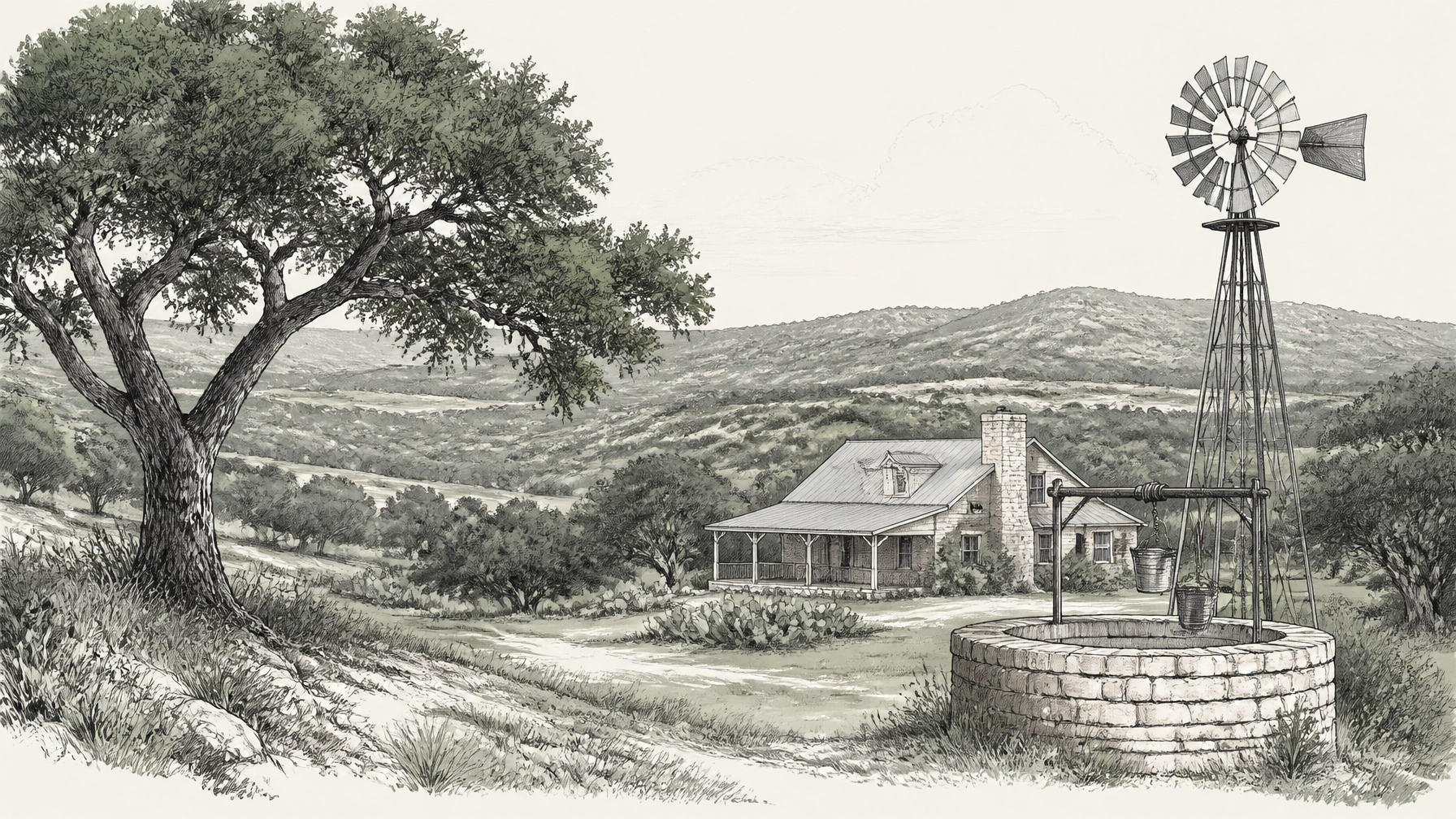
For many retirees, the dream of moving to the Texas Hill Country starts with a vision of rolling vistas, limestone bluffs, and the quiet rustle of live oaks on a sprawling five-acre plot. Whether you are designing a dream home in Boerne or exploring the unique vibes of Fredericksburg and Wimberley, there is one invisible factor that can make or break your retirement sanctuary: water.
Unlike city living, where water appears at the turn of a tap without a second thought, rural Hill Country life often requires you to be your own utility provider. Understanding Texas water rights isn't just about legal jargon; it’s about protecting your lifestyle and your investment.
The Dual Nature of Texas Water
In Texas, water law is divided into two distinct categories: surface water and groundwater. Knowing the difference is the first step in your due diligence.
1. Surface Water: Owned by the State
If your dream property has a bubbling creek or a scenic river frontage, it’s important to understand that you don’t "own" that water in the traditional sense. In Texas, all surface water, rivers, natural streams, and lakes, is considered "state water." It is held in trust for the public.
As a landowner, you generally have "riparian rights," which allow you to use that water for domestic and livestock purposes (like watering your garden or your horses) without a permit. However, if you plan to build a significant pond, irrigate a commercial vineyard, or divert large amounts of water, you must navigate a complex permit system managed by the Texas Commission on Environmental Quality (TCEQ).
2. Groundwater: The "Rule of Capture"
Most Hill Country retirees rely on groundwater accessed via a private well. This is where Texas law becomes truly unique. Texas follows the Rule of Capture, often referred to as the "law of the biggest pump."
Under this rule, groundwater is considered the private property of the landowner. You generally have the right to drill a well and pump the water beneath your land. However, this right is not absolute and is increasingly regulated by local districts.

Navigating the Watchdogs: GCDs and the Edwards Aquifer
While the Rule of Capture provides a baseline of ownership, local authorities exist to ensure that the "biggest pump" doesn't leave everyone else dry.
Groundwater Conservation Districts (GCDs)
Most of the Hill Country is covered by a Groundwater Conservation District. These local entities have the power to:
- Require permits for new wells.
- Set production limits (how many gallons you can pump per day/acre).
- Enforce spacing requirements between your well and your neighbor's.
For example, if you are looking at property in Gillespie County, you’ll need to work with the Hill Country Underground Water Conservation District. They ensure that the local aquifers remain sustainable for everyone.
The Edwards Aquifer Authority (EAA)
If your property sits over the Edwards Aquifer, you are in one of the most strictly regulated water zones in the United States. The EAA manages pumping from this vital resource to protect both the water supply for millions of Texans and the endangered species that live in the springs. Retirees buying in the EAA jurisdiction should expect more stringent permitting and potential limits on non-essential water use during drought stages.

The Hidden Costs of Being Your Own Utility
Buying acreage without municipal water means you are responsible for the "infrastructure" of your home. This is a significant shift for those coming from corporate environments to country roads.
Well Drilling and Maintenance
Drilling a well in the Hill Country is not a guaranteed fixed cost. The depth required can vary wildly based on the local geology and which aquifer you are tapping into (such as the Trinity or the Edwards).
- Drilling Costs: Depending on the depth and rock hardness, a new well system (including the pump, pressure tank, and electrical work) can range from $25,000 to over $50,000.
- Water Quality: Hill Country water is notoriously "hard" (high mineral content). You will almost certainly need a water softener and perhaps a filtration or UV system to ensure the water is palatable and safe.
- Maintenance: Unlike a city bill, well pumps eventually fail, and pressure tanks lose their charge. Setting aside a "well fund" is a prudent part of wealth preservation and retirement planning.
"Water is the lifeblood of the Hill Country. You aren't just buying land; you're buying access to a limited resource. Due diligence on your water rights is just as important as the home inspection." : Mau Sanchez, founder of the Texas Retirement Journal and owner of Mau Sanchez Capital.
Rainwater Harvesting: The Modern Hill Country Solution
Because of the variability of well water and the strictness of local districts, many luxury Hill Country homes are now being built with full-scale rainwater harvesting systems.
These systems collect rain from the roof, store it in large tanks, and treat it to potable standards. In some parts of the Hill Country, homeowners rely entirely on rainwater. This not only provides independence from groundwater districts but often yields "softer" water that is gentler on your home's plumbing.

A Checklist for the Rural Retiree
Before you sign a contract on that beautiful Hill Country acreage, ask these five questions:
- Which Groundwater Conservation District (GCD) governs this property? Check their website for current pumping limits.
- Are the groundwater rights intact? In Texas, water rights can sometimes be "severed" from the land, much like mineral rights. Ensure your title search includes a review of water rights.
- What is the "well log" history? If there is an existing well, ask for the driller's log. It will tell you the depth, the "yield" (gallons per minute), and how the water level has changed over time.
- Has the water been tested recently? Don't just check for bacteria; check for arsenic, nitrates, and high mineral levels.
- Is there a water-sharing agreement? Some smaller developments use a shared well. Be sure you understand the legal maintenance agreement and what happens if the well needs a major repair.
The Fiduciary Perspective
At Mau Sanchez Capital, we often remind our clients that retirement planning extends far beyond the stock market. Your primary residence is likely one of your largest assets. In the Texas Hill Country, the value of that asset is inextricably linked to the availability of water.
When we build portfolios at Mau Sanchez Capital, we focus on liquidity, transparency, and risk management. Buying a property with "uncertain" water rights is a concentrated risk that can impact your net worth and your quality of life. Proper due diligence: much like proper asset allocation: is about preparing for the "what ifs" before they happen.

Retiring to the Hill Country is a rewarding chapter of life, offering a slower pace and a deep connection to nature. By understanding the local water landscape, you can ensure that your "forever home" remains the sanctuary you imagined.
Schedule a private meeting with a fiduciary financial advisor today by calling (512) 593-8380 or by visiting: https://calendly.com/portafoliocapital/15min
Portafolio Capital Management dba Mau Sanchez Capital is a Registered Investment Adviser. This content is for informational purposes only and does not constitute investment advice or a solicitation to buy or sell any security. Advisory services are provided only pursuant to a written advisory agreement.
This article may include stories, scenarios, and perspectives created or assisted by artificial intelligence. Although the individuals and circumstances described may be fictional, the topics are intended to reflect real financial, personal, and lifestyle issues that retirees and individuals commonly face. The content is provided to encourage readers to consider different perspectives that may affect their retirement, regardless of whether they are currently planning, approaching retirement, or already retired. It is intended for general educational and informational purposes only and should not be interpreted as personalized investment, financial, tax, legal, medical, or retirement-planning advice. Individual circumstances vary. Readers should independently verify any information presented and consult appropriately qualified professionals before making financial or personal decisions. No advisory, professional, or client relationship is created through the use of this website.
Leave a Reply